

With the successful sale of your product into an international market, you now must be aware of the differences between shipping domestically and abroad. It is important to create a good checklist to make sure you have everything you need to get your product seamlessly out through US customs and into another country to your end buyer. This is a graphic that shows the basic steps for shipping your product to an export market, for each of these steps, we have broken out the things you need to consider.
Overview of the Export Process
Manufacture
An order is placed, and the product is manufactured.
Origin Warehouse
The product is shipped from the manufacturing plant to a warehouse to be staged for shipment.
U.S. Customs
U.S. Customs reviews export documentation to verify ITAR and EAR compliance.
Inspection
U.S. Customs has the right to inspect any shipments leaving U.S. ports to ensure national security.
Release and Shipment
Upon customs clearance, containers can then be loaded onto vessels for shipment.
Foreign Customs
After arrival or inspection, the cargo is released by customs in the destination country, and permission is given to pick the container(s) up from the port.
Destination
The cargo is picked up and delivered to the destination by either the shipper or the recipient, depending on the Incoterm used.
What modes of transportation are available to move products?
Generally, there are four modes of transportation to move product from one country to another.
- Air
- Ocean
- Rail
- Truck
How do I determine my legal and logistical responsibilities for each leg of shipping my product?
For any shipping transaction, someone is legally and logistically responsible for each piece of the process. Sometimes this responsibility is explicitly stated, and sometimes it's considered common knowledge. For example, when you order something online from a reputable retailer, you expect it to be delivered to you. If it's not delivered, the retailer takes responsibility and either resends the item or refunds the cost.
For commercial shipments, this type of expectation is explicitly stated with terms and agreed upon by both buyer and seller in advance via Incoterms, a pre-defined set of international rules published by the International Chamber of Commerce and used worldwide in commercial transactions.
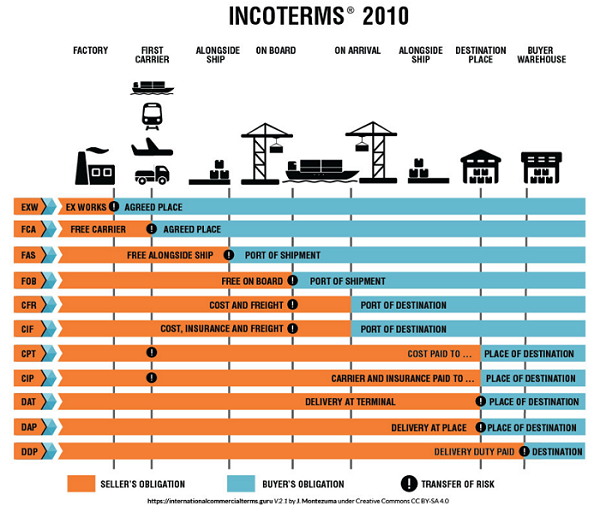
What responsibilities do Incoterms delineate?
Incoterms Tell the buyer and seller the following:
- They define the obligations between the buyer and seller for operations and costs.
- They define the point of passage of risk between buyer and seller in the case of something happening to the product.
- They provide instructions to those handling the goods, e.g., the shipper, freight forwarder, customs brokers and bankers.
Incoterms DO NOT:
- Have any effect on the passage of title for the goods.
- Provide for a mechanism of payment for the goods.
- Cover insurance, with the exception of the C terms, explicitly for the goods.
What do the different terms actually mean?
The following terms apply to any mode of transportation:
- EXW – ExWorks
- FCA – Free Carrier
- CPT – Carriage Paid To
- CIP – Carriage and Insurance Paid
- DAT – Delivered at Terminal
- DAP – Delivered at Place
- DDP – Delivered Duty Paid
The following terms apply only to sea and inland waterway transport:
- FAS – Free Alongside Ship
- FOB – Free on Board
- CFR – Cost and Freight
- CIF – Cost, Insurance and Freight
Step 1: An order is placed
Packing the Product for Export
The demands that international shipping puts on packaged goods can be very specific. Many potential problems, which must be thoughtfully considered beforehand, can arise during shipment. Be sure your goods are prepared using these guidelines:
- Goods are packed in strong containers that are adequately sealed and filled when possible.
- Make sure the weight is evenly distributed to provide proper bracing in the container, regardless of size.
- Put goods on pallets, and when possible, place them in containers.
- Make packages and packing filler out of moisture-resistant material.
- To avoid pilferage, avoid writing contents or brand names on packages.
- Use straps, seals and shrink-wrap to safeguard goods.
- Observe any product-specific hazardous materials packing requirements.
- Verify compliance with packaging documentation and markings for fumigation and chemical treatment.
- Consider special temperatures or conditions that may require the goods be refrigerated, insulated, ventilated, open top, etc.
- Label fragile items such as computer parts, glass, etc.
- Use special packaging as needed, such as anti-theft for expensive items, packaging adapted to the infrastructure of the importing country, etc.
Step 2: Shipping
Labeling Your Shipment
A freight forwarder will help you ship your goods to an international market. Some of those most commonly used in Montana are FedEx, UPS and DHL. These companies have a fleet of vehicles that operate locally and can work to get your product out through U.S. Customs and into your desired region.
Freight Forwarders and Custom Brokers: What is the difference?
Freight forwarders help prepare export documentation, book transport for your products and, if needed, arrange for customs clearance at the port of arrival. You are not required to have a freight forwarder, but they can be useful, especially if you are exporting for the first time, exporting to a new country or prefer someone else to handle these formalities. There are many large shipping and freight companies that fall under this category.
Customs brokers focus on importing goods into a country. They act as an intermediary between the importer and a government’s customs department. Exporters don’t need a U.S. Customs broker because they are shipping out of the country. Whoever is importing will need a customs broker.
How do I know if I need to use a freight forwarder?
If you are shipping large volumes or very large items, a freight forwarder may make sense for you. If your shipments are smaller, you may be better off using a familiar parcel shipping company like UPS, FedEx or DHL. These companies can take care of shipping and import clearance, as they often have their own brokerage services.
Step 3: U.S. and Foreign customs
Mandatory Documentation for Every Shipment
- Airway bill
- Bill of lading
- Commercial invoice
- Shipper’s letter of instruction
- Packing list
- Information filed in the automated export system
Possible Other Documentation
- Certificate of Origin
- NAFTA Certification
- Certificate of Free Sale
Insurance
Insurance can be purchased through private banking or through a freight forwarder or shipper. However, the U.S. government has a low-cost alternative for many shipping and payment services through EXIM Bank. Read about Montana businesses that have used their services and contact our regional representative for more information.
Step 4: Next Steps
- Certifications
- Labeling of your product
What if I want to temporarily export my goods then bring them back?
- ATA carnet: This is like a passport for your goods. It is an international customs document that permits the tax-free and duty-free temporary export and import of nonperishable goods for up to one year. Examples of when you might use this are for commercial samples, professional equipment and goods used for presentations at trade shows. In the U.S., ATA carnets are issued by the International Chamber of Commerce. There is a fee to get a carnet based on the value of the good, a cost to bond your good when overseas and some processing fees. Here is list outlining some of these fees.
- Temporary import in bond: These are used in a very specific manner for certain products. Goods do not need to be returned to their country of origin, they just need to leave or be destroyed in the country they were brought to. These typically last one year, and a bond, usually in the amount of double the normal duty, must be paid. This is a more complicated and nuanced option. An example of when you might use this is when you were exporting a number of goods to be tested, destroying some of those goods that did not meet qualifications, then exporting those goods that passed a test along to other countries.
- Duty drawback: Duty drawback is a refund of 99% of the duties paid on goods imported into the United States that are then exported, with the purpose of encouraging manufacturing and exports. Examples of when this might be used are when component pieces are imported then exported as part of finished product or when products are imported, then exported. Documentation is required showing duties paid, manufacturing and export.
Montana’s Foreign-Trade Zones:
- FTZ No. 274 in Butte–Silver Bow, where the Port of Montana operates a general-purpose FTZ warehouse
- FTZ No. 88 in Great Falls, associated with the Great Falls International Airport and serving the surrounding industrial area.
- FTZ No. 187 in Toole County, covering the Sweetgrass Port of Entry and the Port of Northern Montana at Shelby.
What is an FTZ, and how can they help?
FTZs are secure, designated locations in or near U.S. Customs ports of entry where companies can bring in foreign goods and delay, reduce or sometimes eliminate customs duties.
Typical benefits include duty deferral while goods are in the zone; no duties on re-exports; potential inverted tariffs on finished goods; and relief from duties on scrap, waste and certain zone-related logistics activities.
Using an FTZ can streamline customs procedures, such as with weekly entry, and support just-in-time inventory strategies, improving cash flow and supply-chain reliability for manufacturers, distributors and logistics operators.
For more information, visit naftz.org/basics-benefits.
More information
If you need further information on transportation, please reach out.
Contact Us